
LG Electronics India made a dazzling market debut on Tuesday, ending 48 per cent higher than its issue price and surpassing its South Korean parent in market value.

'First, develop the ability to sell -- to persuade, negotiate and close. Second, understand the financial mechanics that determine where value pools and how profits are captured,' says Shaadi.com founder Anupam Mittal.

The sector's IPO pipeline is led by Tata Capital's Rs 17,000 crore issue, followed by ICICI Prudential Asset Management at Rs 10,200 crore and Billionbrains Garage Ventures at Rs 6,000 crore.

Among Sensex firms, Eternal, Sun Pharma, Infosys, HDFC Bank, HCL Tech, Hindustan Unilever, Power Grid, ITC and Adani Ports were the major gainers. However, Tata Motors, Trent, Bajaj Finance and Asian Paints were among the laggards.

The stock of Bharat Electronics (BEL) has risen 10 per cent over the past seven to eight trading sessions, driven by order wins that improve revenue visibility. The gains mark a reversal of a declining trend in its stock price between early July and late August, during which the scrip fell over 13 per cent.

From the Sensex firms, Infosys, Tata Consultancy Services, HCL Tech, Tech Mahindra, Tata Motors, Sun Pharma, Maruti and Titan were among the major gainers. Bharat Electronics, Asian Paints, Bharti Airtel and ICICI Bank were among the laggards.
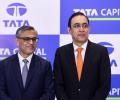
Tata Capital Ltd, set to launch its IPO next week, has identified green financing and digital innovation as its core growth pillars, backed by the merger of its IFC-backed subsidiary Tata Cleantech Capital in 2024. By FY25, the cleantech and infrastructure finance book reached Rs 18,000 crore, growing at a 31.8 per cent CAGR over the last two years, the NBFC said on Friday.

The Adani Group plans to invest a record $15-20 billion across businesses over the next five years to chart out the next phase of growth, chairman Gautam Adani said on Tuesday as he touted the conglomerate's strong balance sheet and robust business to shrug off relentless scrutiny it faces. Record earnings from the businesses ranging from seaports to airports, renewable energy parks to data centres, cement to gas and electricity has built India's largest infrastructure group that not only exists just to serve the markets but to serve the nation's destiny, he said.
Goldman Sachs is bullish about Indian aerospace and defence, preferring private companies over public sector units (PSUs) as the country ramps up its export target for the sector to Rs 50,000 crore by FY29 from Rs 23,600 crore last year. The American investment bank's top 'buy' recommendations include Solar Industries, Bharat Electronics, Data Patterns and PTC Industries, while Bharat Dynamics is rated 'sell'.

After heavy selling in the past two months, foreign investors have staged a strong comeback to Indian equities with a net investment of Rs 24,454 crore in the first week of December amid stabilising global conditions and expectations of potential US Federal Reserve rate cuts. This revival follows significant outflows in the preceding months, with foreign portfolio investors (FPIs) pulling out a net Rs 21,612 crore in November and a massive Rs 94,017 crore in October - the worst monthly outflow on record.

The fee pocketed by investment banks for handling equity share sales stood at $244 million during the first half of calendar year 2024. This was the highest first half figure since 2007, according to LSEG Data & Analytics, a provider of financial markets data. Capital mobilised via equity capital market (ECM) activity jumped 2.5 times to $29.5 billion - the highest-ever semi-annual total in terms of proceeds.

Do home prices really never fall? Ramalingam Kalirajan begs to differ.

'Such stocks may be useful for aggressive portfolios, but should not be part of the core holdings.'

Foreign investors have injected close to Rs 33,700 crore in domestic equities in this month so far primarily due to interest rate cut in the US and resilience of the Indian market. This also marks the second highest inflow in a month in this year so far, the last one being in March, when Foreign Portfolio Investors (FPIs) infused Rs 35,100 crore, data with the depositories showed. Going ahead, the trend of FPIs buying is likely to continue in the coming days, V K Vijayakumar, Chief Investment Strategist, Geojit Financial Services, said.

The mutual fund industry's QAAUM (Quarterly Average Assets Under Management) was up 37 per cent year-on-year (Y-o-Y) (9 per cent Q-o-Q) to hit Rs 59 trillion (end Q1FY25). The equity segment grew 55 per cent Y-o-Y and equity formed 56 per cent of total AUM, up 49 per cent in Q1FY24. Sequentially, AUM grew by Rs 5 trillion.

Non-banking financial company (NBFC) Tata Capital is set to launch its much-anticipated $2 billion (Rs 17,200 crore) initial public offering (IPO) in the week beginning September 22, market sources familiar with the matter said on Sunday. The issue is expected to value the company around $11 billion, they added. Tata Capital is likely to make its stock market debut by September 30.

Foreign investors have continued selling in the Indian market, pulling out a massive Rs 85,790 crore (around $10.2 billion) from equities this month due to Chinese stimulus measures, attractive stock valuations, and the elevated pricing of domestic equities. October is turning into the worst-ever month in terms of foreign fund outflows. In March 2020, FPIs withdrew Rs 61,973 crore from equities.

Ask rediffGURU Reetika Sharma your insurance mutual fund and personal finance-related questions.

Foreign investors pulled out a massive Rs 94,000 crore (around $11.2 billion) from the Indian stock market in October, making it the worst-ever month in terms of outflows, triggered by the elevated valuation of domestic equities and attractive valuations of Chinese stocks. Before this, foreign portfolio investors (FPIs) withdrew Rs 61,973 crore from equities in March 2020. The latest outflow came after a nine-month high investment of Rs 57,724 crore in September 2024.

Among Sensex firms, Eternal, Infosys, Asian Paints, HDFC Bank, Bajaj Finserv and Titan were the major gainers. However, Tata Steel, Tech Mahindra, Adani Ports and Bharat Electronics were among the laggards.

India's top information- technology (IT) services companies, all cash-rich, have been tightfisted about ploughing back their earnings in new projects or acquisitions and the bulk of the profits have been distributed to shareholders through dividend and share buybacks. In the past 10 years (that is, excluding the current one), the firms have reinvested in growth and expansion only around 13.5 per cent of the cash flow generated from their operations.

Co-working spaces provider WeWork India is aiming for a revenue growth of over 20 per cent for the coming years, even as its initial public offering (IPO) with only an offer for sale (OFS) component gets valued at Rs 3,000 crore at the top of the price band. The IPO opens on October 3, a newspaper advertisement said.

While Amitabh Bachchan's chemistry with his heroines -- from Jaya Bhaduri to Rekha to Hema Malini -- brought sizzle to his films, many of his biggest blockbusters have been powered by his combustible combination with male co-stars.

The Supreme Court has permitted the sale and bursting of green crackers in Delhi-NCR for Diwali, relaxing the ban on green firecrackers as a temporary measure from October 18 to 21. The court has asked pollution control boards to monitor pollution levels and file reports. The order also includes measures to prevent the sale of non-compliant crackers.

Investor sentiment across Asian markets has shifted sharply in August, reveals the latest Bank of America (BofA) Fund Manager Survey, which found global growth expectations retreating after three months of improvement.

The value of private equity (PE)-backed mergers and acquisitions (M&As) in India reached a six-year low during the first seven months of the current calendar year, amid ongoing global uncertainties. The total value of these deals stood at $6.2 billion during the period, down from $9 billion in the same period last year, and lower than the $14 billion recorded during the corresponding period in 2019, according to data from LSEG Deals Intelligence. PE funds pool capital from investors, including high-net-worth individuals, to invest in high-return opportunities.

The rupee is undervalued as compared to its peers, shows the latest data from the Reserve Bank of India (RBI), even as the local currency keeps hitting new lows.

'A price of $6,600/oz is now a reasonable target for gold.'

: Build lasting wealth via disciplined, long-term mutual fund investing in India's compounding marathon, Shanaihi, Shanaihi, says Ramalingam Kalirajan

While the economy will wait for a rate cut in December, the banking industry should be happy with the wave of liberalisation -- a big push for growth in bank credit, points out Tamal Bandyopadhyay.

Reliance holds 67.03% of Jio Platforms Limited and the public listing would provide an exit to many investors.
Foreign investors have made a strong comeback to Indian equities with a net investment of Rs 22,766 crore in the first two weeks of December driven by expectations of rate cut by the US Federal Reserve. This revival follows significant outflows in the preceding months, with Foreign Portfolio Investors (FPIs) pulling out a net Rs 21,612 crore in November and a massive Rs 94,017 crore in October -- the worst monthly outflow on record.

Concerns over weakening demand for Indian pharmaceutical (pharma) drugs in the US - their largest export market - have weighed heavily on investor sentiment this year. While the Nifty 50 has gained 6.02 per cent year - to - date (as on September 15), the Nifty Pharma index has declined 5.18 per cent, National Stock Exchange data shows.

Post the change in debt fund taxation in March, a lesser-known hybrid fund has emerged as one of the alternatives for fixed-income investors. Equity savings schemes, the smallest hybrid fund category in terms of assets, have raked in around Rs 6,000 crore this financial year (FY24) so far compared to Rs 1,100-crore outflow in FY23. The inflows along with a strong performance led to a 50 per cent surge in assets under management (AUM) to Rs 24,100 crore during April-November, shows data from the Association of Mutual Funds in India (Amfi).

Plans for big bang reforms in the GST regime by Diwali, the Putin-Trump summit and S&P upgrading India's sovereign credit rating are likely to instil optimism in the domestic equity market in the week ahead, analysts said. Besides, trends in global markets and the trading activity of foreign investors would also impact domestic investors' sentiment.

Foreign portfolio investors sold stocks worth Rs 1.42 trillion in 2025, with their sales hitting Rs 12,257 crore in the first four trading days of September.

'Long-short SIFs are designed for seasoned, high-risk, high-reward investors, who understand market volatility.'

The more things change, the more they remain the same for corporate India. In the April-June 2025 period (Q1FY26) - for the ninth consecutive quarter - listed companies witnessed only single-digit revenue growth, while their core earnings, excluding other income and one-time gains, contracted for the second time in four quarters. This comes as firms brace for the impact of 50 per cent US tariff on Indian goods.

Arbitrage funds, the new favourite of individual investors, delivered their best performance in nearly a decade in 2024. On average, the schemes delivered 8 per cent return last year, the highest since 2016, according to data from Value Research. The returns were supported by positive equity market sentiments, surge in open interest in stock futures, high interest rate, among other factors, analysts said.

'I expect IT stocks to trade lower for some time. They are unlikely to make money for investors.'
